
MULTIVAC Marking & Inspection At IFFA 2013
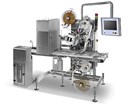
MULTIVAC Marking & Inspection has now also achieved, with its cross web and conveyor belt labellers, that which has been standard for some time with its direct web printers: namely, the integration of the control of these labellers in the MULTIVAC HMI 2.0 control terminal, which is used in the new generation of MULTIVAC packaging machines. Users, who are already familiar with this user interface, can now also operate the labelling systems from MULTIVAC Marking & Inspection via the same terminal.
The integration of these labelling and marking systems in the MULTIVAC HMI 2.0 has other benefits for the user: thanks to the linking of processes in an integrated packaging line, which is controlled centrally via one HMI 2.0 user interface, the operation of the label-ling or marking system also becomes more intuitive and efficient. One example of this is the automatic loading of the labeller's con-figuration and print layouts, when the recipe selection is being made for the thermoforming packaging machine. Such combined processes contribute to preventing errors. The training for custom-ers' employees, who operate or maintain the labelling or marking systems, is also simpler, particularly if they are already familiar with the HMI 2.0 from their experience with the packaging machine. In addition to this, only one data backup is necessary.
Fewer control terminals also mean less cabling, as well as ma-chines which are easier to control, particularly since MULTIVAC Marking & Inspection has also integrated other components in the HMI 2.0, such as for example the MULTIVAC TTO 10/20 thermal transfer printers or the MULTIVAC Vision System (MVS).
Quick-control display for basic functions
There are also other benefits - depending on the layout of the packaging line - from the integration of cross web labellers in the HMI 2.0, and MULTIVAC Marking & Inspection will be demonstrat-ing these benefits at IFFA 2013. A single HMI 2.0 user interface will usually be sufficient, with relatively short and easily controlled lines, to operate the whole packaging line and all its labelling or marking components.
It is however more sensible with long packaging lines to operate with two HMI 2.0 terminals, since otherwise the operators have to walk relatively long distances. "This configuration is also recom-mended for example in the food sector, if there is a wall separating the high-risk area from the low-risk area", says Robert Vollenkem-per, Sales Manager of MULTIVAC Marking & Inspection. The cross web labellers can then in this case be equipped with an additional HMI 2.0, in which the control terminal of the packaging machine is displayed on a 1:1 basis. This means that the functions of the packaging machine are also accessible from here, which creates even more ease of operation and flexibility.
MULTIVAC cross web labellers can also be equipped with a quick-control display, which enables a minimum level of operation to be accessed. Users can call up basic functions of the labeller on this panel, such as for example the measuring run, when changing to other label formats during a batch change. All other settings are made via the HMI 2.0 at the packaging machine.
HMI 2.0 for conveyor belt labellers: printer control panels are no longer required
MULTIVAC Marking & Inspection will also be showing at IFFA 2013 the benefits of HMI 2.0 integration for this series of labeller, using the MR337 conveyor belt labeller, which operates continuously without interruption for label changes. If top and bottom labels are printed - for example the use-by date on the top label and a bar-code on the bottom label - then all four label dispensers on the la-belling system are equipped with printers. "The MR377 SQ required up to now four printer control panels in such a case. With the new labeller version with HMI 2.0 integration and MULTIVAC TTO printers, the four panels are no longer required. The whole operation is performed via a single HMI 2.0", emphasizes Vollenkemper.
Source: MULTIVAC