
Endress+Hauser Unveils Picomag Electromagnetic Flowmeter Variant For Data Centers And OEM Applications In US Market
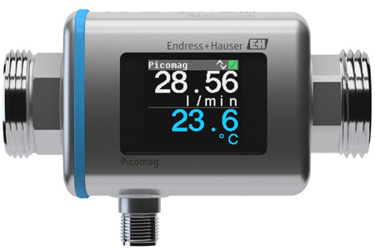
Flow device primed for security in data center and OEM applications at various stages of the liquid cooling process
Endress+Hauser today announces a new OEM‑configured variant of the Picomag electromagnetic flowmeter for the US market. Purpose‑built for liquid cooling applications in data centers and OEM cooling systems, this version provides customers with a factory‑configured option designed for environments where instrumentation without wireless connectivity is required.
Picomag is Endress+Hauser’s compact electromagnetic flowmeter designed for accurate measurement of conductive fluids in small‑diameter pipelines. It combines flow, temperature and conductivity measurement in a single device.
While the standard Picomag includes industry‑leading Bluetooth® technology that meets rigorous global cybersecurity standards, many data centers and OEM partners operate under policies that prohibit wireless communication of any kind. The OEM variant meets this operational preference by offering a Picomag model delivered with Bluetooth® deactivated from the factory, ensuring alignment with facility policies while maintaining all core Picomag performance capabilities. In this configuration, the device integrates seamlessly through IO‑Link or standard signal outputs — 4–20 mA current, pulse, switch or 2–10 V — offering a controlled starting point ideal for secure or regulated environments.
"Data centers operate under some of the most demanding security expectations in the world,” said Nathan Hedrick, Product Marketing Group Manager at Endress+Hauser. “This OEM Picomag gives cooling system designers a compact, reliable and secure measurement option tailored for environments where wireless features are not permitted without compromising on the functionality our customers expect.”
Purpose‑built for high‑security data center environments
The OEM Picomag variant is designed to integrate seamlessly into standardized cooling skids, secondary distribution loops and rack‑level cooling modules. Key characteristics include:
- Factory‑delivered with wireless connectivity deactivated to meet strict facility requirements
- Preconfigured display behavior, output settings and engineering units for consistent OEM deployment
- Available in 1” and 2” sizes, ideal for compact rack or subsystem cooling circuits
This version retains all Picomag’s hallmark advantages, including flow, temperature and conductivity measurement, a bright and auto‑rotating display, intuitive commissioning and built‑in diagnostic capabilities.
“This addition strengthens our ability to support every stage of a data center facility’s cooling architecture,” said Lauton Rushford, Flow Product Marketing Manager at Endress+Hauser. “It ensures operators and OEMs can select instrumentation that aligns with their policies while benefiting from Picomag’s proven performance and simplicity.”
How does liquid cooling compare to traditional air cooling in data centers?
As data centers grow in density and power consumption, many operators are shifting from traditional air-cooling systems to liquid cooling architectures. Liquid cooling offers significantly greater heat‑removal efficiency, allowing facilities to manage higher thermal loads generated by modern CPUs and GPUs.
While air cooling relies on large volumes of conditioned airflow, liquid cooling absorbs and transports heat far more effectively, supporting higher rack densities, reducing energy use and enabling more compact system designs. This shift is especially pronounced in AI, hyperscale and high‑performance computing environments where equipment demands exceed what air cooling alone can accommodate.
Liquid cooling also supports more precise thermal management at the subsystem or rack level. This creates new measurement requirements for inline flow and temperature monitoring, which is where compact, secure devices like the OEM Picomag play a key role.
What are the latest trends in data center optimization technology?
As data centers adopt increasingly complex liquid‑cooling architectures driven by high‑density GPU workloads, AI clusters and expanding global capacity, operators need compact, accurate measurement at more distributed points throughout the cooling network.
The OEM Picomag complements Endress+Hauser’s broader flow portfolio, including Proline Promag W 300/500 (0xDN), enabling a complete, scalable measurement strategy spanning from large‑diameter primary loops to small‑diameter subsystem circuits.
Stable water quality is also essential for maintaining liquid cooling efficiency. Complementary technologies such as inline liquid analysis (e.g., pH, conductivity and turbidity) help operators prevent scaling, corrosion and fouling, further supporting uptime and thermal stability.
Endress+Hauser enables operators and OEM partners to build cooling systems that are efficient, scalable and aligned with their security and operational policies.
To learn more, click here.
About Endress+Hauser
Endress+Hauser is a global leader in measurement and automation technology for process and laboratory applications. The family company, headquartered in Reinach, Switzerland, achieved net sales of more than 3.7 billion euros in 2024 with a total workforce of over 17,000.
Endress+Hauser devices, solutions and services are at home in many industries. Customers thus use them to gain valuable knowledge from their applications. This enables them to improve their products, work economically and at the same time protect people and the environment.
Endress+Hauser is a reliable partner worldwide. Its own sales companies in more than 50 countries as well as representatives in another 70 countries ensure competent support. Production facilities on four continents manufacture quickly and flexibly to the highest quality standards.
Endress+Hauser was founded in 1953 by Georg H Endress and Ludwig Hauser. Ever since, the company has been pushing ahead with the development and use of innovative technologies, now helping to shape the industry’s digital transformation. Over 9,000 patents and applications protect the Group’s intellectual property.
For further information, please visit www.endress.com/media-center or www.endress.com
Source: Endress+Hauser, Inc.